The Continuous Governance Engineering Lifecycle™
Most governance programs fail in the same two places: at the beginning, where regulation is never translated into enforceable requirements, and at the end, where deployed systems drift while documentation stands still. The Continuous Governance Engineering Lifecycle™ was designed to close both gaps.
It is a nine-stage methodology for engineering governance as a living system: regulation is translated into requirements, requirements into design, design into workflow, and workflow into execution, with human oversight, evidence, and transparency enforced at every step, and a continuous feedback loop returning real-world performance to the governance function.
Governance is not what is defined. It is what is enforced at execution.
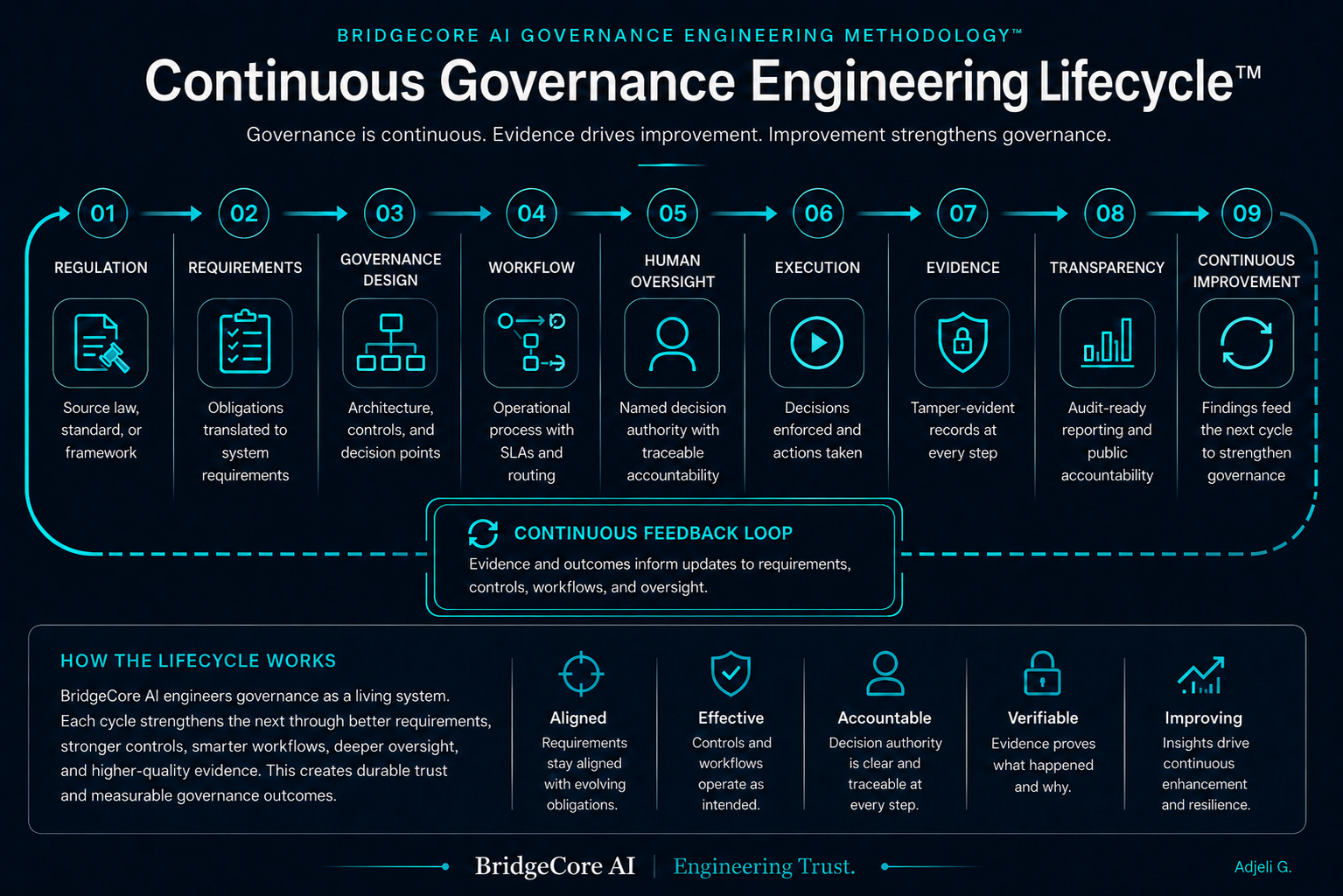
The Continuous Governance Engineering Lifecycle™. The highlighted feedback loop returns execution evidence and real-world performance to continuous improvement, so governance evolves as fast as the systems it governs.
Governance, engineered end to end.
Regulation
Identify and interpret the regulatory obligations, standards, and policy commitments that apply to the system, including ISO 42001, the EU AI Act, and the NIST AI Risk Management Framework.
Requirements
Translate obligations into precise, testable, and enforceable requirements. This is the first point where most governance programs fail; it is where ours begins.
Governance Design
Architect the controls, accountability structures, and decision rights that will carry those requirements into operation.
Workflow
Embed governance into the actual paths of work, so compliance is a property of the process, not an after-the-fact review.
Human Oversight
Define where humans must decide, approve, intervene, or override, and engineer those points into the system rather than assuming them.
Execution
Enforce governance at runtime, at the moment decisions are made and actions are taken, where policy becomes behavior.
Evidence
Capture contemporaneous, auditable evidence of what the system did, what was enforced, and who decided, as a byproduct of execution.
Transparency
Make governance posture visible to executives, auditors, regulators, and affected stakeholders, in forms each can act on.
Continuous Improvement
Feed execution evidence and real-world performance back into regulation, requirements, and design. This is the second point where most programs fail, and the loop that keeps governance alive.
Governance that learns is governance that lasts.
A static framework documents intent. A living lifecycle enforces it, proves it, and improves it. That is what we mean by Engineering Trust.
The complete methodology, including the lifecycle diagram, is published openly on our GitHub.